Skip to content

Stem Cell Research Timeline

The information used to compile this Stem Cell Research Timeline comes from many different sources, including ScienceProgress.org and the National Institutes of Health.

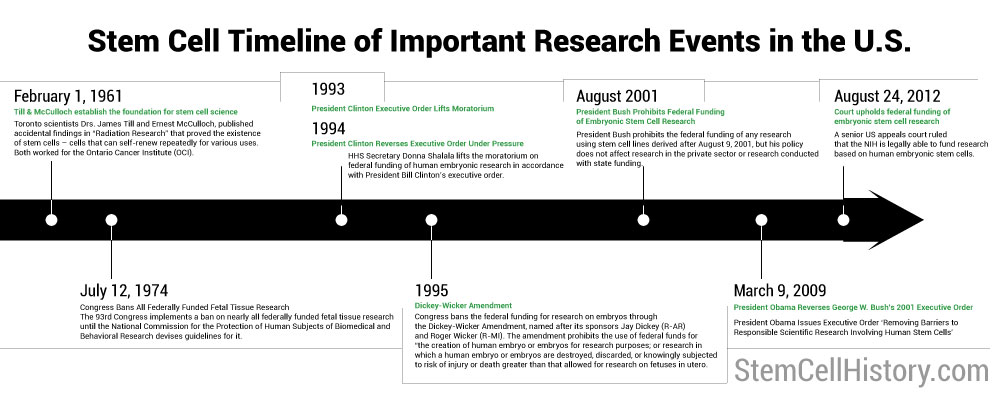
February 1, 1961: Till & McCulloch establish the foundation for stem cell science.

  • Toronto scientists Drs. James Till, a biophysicist, and Ernest McCulloch, a haematologist, published accidental findings in “Radiation Research” that proved the existence of stem cells – cells that can self-renew repeatedly for various uses. Both worked for the Ontario Cancer Institute (OCI) at the time.
July 12, 1974:  Congress Bans All Federally Funded Fetal Tissue Research
  • The 93rd Congress implements a ban on nearly all federally funded fetal tissue research until the National Commission for the Protection of Human Subjects of Biomedical and Behavioral Research devises guidelines for it.
July 12, 1974:  National Commission for the Protection of Human Subjects of Biomedical and Behavioral Research
  • The National Research Act established the National Commission for the Protection of Human Subjects of Biomedical and Behavioral Research within the Department of Health, Education, and Welfare to define policy for protection of human subjects during medical and/or scientific experiments.
1975:  Ethics Advisory Board Established
  • Guidelines establish an Ethics Advisory Board for fetal and fetal tissue research that originate from abortions.
1980:  President Reagan Kills Ethics Advisory Board
  • President Ronald Reagan decides not to renew the Ethics Advisory Board’s charter. The EAB had recommended federally funded investigations into the safety of in vitro fertilization using human embryos developed in vitro for no more than 14 days, but a de facto moratorium halts federal funding of human embryo research due to the EAB’s disbanding.
1988:  Federal Panel Approves Funding of Embryo Research
  • Human Fetal Tissue Transplantation Research Panel reopens the question and votes 18-3 to approve the federal funding of embryo research. Despite this level of support for the research, the Department of Health and Human Services accepts the testimony of three conservative dissenters who argue that embryonic research would lead to an increase in abortions, and in response, extends the moratorium on this research.
1990:  President George H.W. Bush Vetos Bill Lifting Moratorium
  • Congress attempts to override the moratorium through legislation but President George H.W. Bush vetoes the measure.
1993:  President Clinton Executive Order Lifts Moratorium
  • HHS Secretary Donna Shalala lifts the moratorium on federal funding of human embryonic research in accordance with President Bill Clinton’s executive order.
1994:  President Clintion Reverses Order
  • A National Institutes of Health human embryonic researcher panel supports the research but thousands of letters urge President Clinton to reverse his earlier decision. He agrees and federal funding of embryonic research is halted.
1995:  Dickey-Wicker Amendment
  • Congress bans the federal funding for research on embryos through the Dickey-Wicker Amendment, named after its sponsors Jay Dickey (R-AR) and Roger Wicker (R-MI). The amendment prohibits the use of federal funds for “the creation of human embryo or embryos for research purposes; or research in which a human embryo or embryos are destroyed, discarded, or knowingly subjected to risk of injury or death greater than that allowed for research on fetuses in utero.
1998:  James Thomson Isolates Human Embryonic Stem Cells
  • University of Wisconsin scientist James Thomson isolates human embryonic stem cells and shows their potential to rejuvenate and to specialize into tissues. This discovery also initiates the ethical debate on human embryonic stem cell research because his team derives the stem cells through a process that destroys human embryos.
January 1999:  HHS Legal Opinion OKs Research on hESC Lines
  • NIH Director Harold Varmus receives a legal opinion from DHHS general council Harriet Rabb. Rabb finds that the Dickey-Wicker amendment does not apply to federal funding for research on embryonic stem cells because the cells do not meet the statutory definition of an embryo. The cells, however, would have to be derived with private funding.
April 1999:  Harold Varmus Appoints Oversight Committee
  • Harold Varmus appoints an oversight committee to draft guidelines for federally funding embryonic stem cells. The committee includes scientists, clinicians, ethicists, lawyers, patients, and patent advocates.
1999 to 2000: NIH Guidelines and Bush Disapproval
  • The NIH develops guidelines for funding human embryonic stem cell research, but presidential candidate George W. Bush declares his opposition to the research in a campaign speech, so the NIH remains cautious about entertaining funding proposals until after the presidential election.
February 2000: Influx of Reponses on Proposed Guidelines
  • Over 50,000 responses had been received on the committee’s proposed guidelines.
August 25, 2000: NIH Guidelines for Research Go Into Effect
  • NIH Guidelines for Research Using Human Pluripotent Stem Cells are published in the Federal Register over the summer and go into effect. They stipulate: human embryonic stem cells must be derived with private funds from frozen embryos from fertility clinics; they must have been created for fertility treatment purposes; be in excess of the donor’s clinical need; and obtained with the consent of the donor. These guidelines also outlawed the federal funding of stem cells derived from embryos created by SCNT, even if the derivation took place with private funds.
April 2001: Grant Application Review Postponed for Bush Administration
  • NIH postpones reviewing grant applications for human embryonic stem cell research in order to give the Bush administration time to review HHS policies.
August 2001: President Bush Prohibits Federal Funding of Human Embryonic Stem Cell Research
  • President Bush prohibits the federal funding of any research using stem cell lines derived after August 9, 2001, but his policy does not affect research in the private sector or research conducted with state funding. The president claims that more than 60 stem cell lines are available for funding.
January 2004: President’s Council on Bioethic: “Monitoring Stem Cell Research”
  • The President’s Council on Bioethics, chaired by Leon Kass, publishes Monitoring Stem Cell Research, a report that contains “no proposed guidelines and regulations, nor indeed any specific recommendations for public policy.” But according to Kass, the overarching goal of the report is “to convey the moral and social importance of the issue at hand and to demonstrate how people of different backgrounds, ethical beliefs, and policy preferences can reason together about it.”
April 26, 2005: National Academies Releases “Guidelines for Human Embryonic Stem Cell Research”
  • The National Academies releases its “Guidelines for Human Embryonic Stem Cell Research.” In the news release, committee co-chair Richard O. Hynes explains, “A standard set of requirements for deriving, storing, distributing, and using embryonic stem cell lines – one to which the entire U.S. scientific community adheres- is the best way for this research to move forward.”
May 2005: President’s Council on Bioethics: “Alternative Sources of Pluripotent Stem Cells”
  • The President’s Council on Bioethics releases a white paper titled “Alternative Sources of Pluripotent Stem Cells”
December 21, 2006: ISSCR Guidelines
  • The International Society for Stem Cell Research releases its “Guidelines for the Conduct of Human Embryonic Stem Cell Research.”
April 30, 2007: New NAS Guidelines
  • The National Academies releases the 2007 amendments for its guidelines.
June 20, 2007: President Bush Calls for Work on Alternate Sources
  • President Bush issues an executive order calling upon the HHS secretary to support and encourage research on alternative sources of pluripotent stem cells. He also requests that the Human Embryonic Stem Cell Registry be renamed the Human Pluripotent Stem Cell Registry.
November 2007: Yamanaka and Thomson Independently Derive iPS Cells
  • Shinya Yamanaka of Kyoto University and James Thomson of the University of Wisconsin-Madison both publish papers on their separate discoveries of induced pluripotent stem cells. These pluripotent cells were created from skin cells that had four genes inserted into them with viruses. This procedure resulted in the skin cells acquiring properties similar to embryonic stem cells. Researchers were able to coax these so-called iPS cells into becoming beating heart cells and nerve cells.
May 2008: Report: Only 16 of 21 Lines Eligible for Federally Funding Were Ethically Derived
  • Robert Streiffer, a bioethicist at the University of Wisconsin-Madison, publishes a paper detailing his investigation into the consent forms for the federally approved human embryonic stem cell lines. Although 21 lines were viable at the time, he discovers that no more than 16 are both viable and ethically derived.
September 5, 2008: NAS Release New Guidelines
  • The National Academies releases the 2008 amendments for its guidelines.
December 3, 2008: ISSCR Releases Guidelines for Clinical Translation
  • The International Society for Stem Cell Research releases its new Guidelines for the Clinical Translation of Stem Cells
January 20, 2009: New Administration Begins
  • Barack Obama is sworn in as the 44th president of the United States, having promised to change the current restrictions on human embryonic stem cell research.
March 9, 2009: President Obama Reverses George W. Bush’s 2001 Executive Order
  • President Obama Issues Executive Order: Removing Barriers to Responsible Scientific Research Involving Human Stem Cells

October 11, 2010: Geron Initiates Clinical Trial of Human Embryonic Stem Cell-Based Therapy

  • Geron Corporation announced the enrollment of the first patient in the company’s clinical trial of human embryonic stem cell (hESC)-derived oligodendrocyte progenitor cells, GRNOPC1.

November 22, 2010: Advanced Cell Technology Wins FDA Approval To Test Stem Cell Therapy For Degenerative Eye Disease

  • Regenerative medicine company Advanced Cell Technology received federal approval from the US FDA to begin a multi-centre clinical trial that tests human embryonic stem cell treatment on patients with Stargardt’s Macular Dystrophy, a disease that causes blindness.

January 20, 2011: Stem cell pioneer Ernest McCulloch dies

  • Ernest McCulloch, who was part of the team that first proved the existence of stem cells, died at the age of 84 just days before a celebration to mark the 50th anniversary of the discovery. The cause of death is unknown. McCulloch was born in Toronto and worked as a lead researcher at the Ontario Cancer Institute and the Institute of Medical Science at the University of Toronto.

The Stem Cell Research Controversy

By Tyler Lanza


Stem cell research has presented the nation with one of the most divisive ethical issues of the modern age. Aside from the biological implications of stem cell research, many question the morality of issues involving embryos, cloning, and genetic engineering, to identify a few.

While the debate is relatively new, it is rapidly becoming one of the most controversial ethical issues of today. As with most technological advances, the key question is not whether progress is right or wrong, but rather will society use the new power responsibly.

To provide some scientific background on the issue, a stem cell is a cell that has the potential to develop into a number of different types of cells in the body. First discovered in the early 1900s, stem cells were identified and named when researchers realized that various types of blood cells all originated from a particular “stem cell” (UKSCF, 2007).

When a stem cell divides, each new cell has the potential to either remain the same or become another type of cell in the body with a more specialized function, such as a brain cell, red blood cell, or muscle cell (U.S. Dept. of Health, 2009). For this reason, stem cells are expected to be able to effectively treat a wide variety of diseases and ailments, including spinal cord injury, diabetes, heart disease, blood disorders, and Parkinson’s Disease.

Another potential function of stem cells is the ability to create cells, tissue, and even synthetic blood that can be used in medical therapies (AGI News, 2009), thus closing the gap between the high demand for donated organs and tissues and the limited supply currently available for patients in need.

There are two types of stem cells with which scientists can work: adult and embryonic.

Most of the controversy surrounding stem cell research involves embryonic stem cells because they are derived from fertilized embryos, which are subsequently destroyed in the research process.

The embryos used for research, however, are not derived from eggs fertilized in a woman’s body; rather they are fertilized in vitro in a fertilization clinic and donated for research purposes with informed consent of the donor (Newman, 2009). If they are not used to contribute to the medical community, these embryos will be kept deep frozen in a clinic or discarded altogether. It is for this reason that many supporters of stem cell research argue that the process cannot be accurately compared to destroying human life if the embryo’s ultimate fate was going to be disposal from the onset of the procedure. It is also not clear as to whether or not the biological fetus is a person and has rights (Garrett, Baille, & Garrett, 2001).

An adult (or somatic) stem cell, on the other hand, is an undifferentiated cell found among differentiated cells in an organ or tissue that has the ability to renew itself, as well as differentiate into a specialized cell type. By their nature, adult stem cells are not as controversial because they can be derived from an individual who may require the therapy by extracting them from the bone marrow or skin cells (National Institues of Health, 2009).

Stem cells, however, do not come only from embryos, bone marrow, and skin. A popular service called cord blood banking is now offered to the families of newborn infants who want to preserve a child’s stem cells after birth so that they may be accessed later should stem cell therapy ever become necessary. The cells derived from the baby’s umbilical cord can also be used to treat blood relatives. If a family decides not to store these cells by having them frozen after birth, then the genetically unique cord blood stem cells are discarded (Cord Blood Registry, 2009).

Perhaps on its basis in science and progress as well as ethics and morality, stem cell research has proven to be a highly charged political topic. On August 9, 2001, former president George W. Bush signed an executive order declaring that federal funding for stem cell research could only be used for existing stem cell lines created before that day. Of the 60 embryonic stem cell lines authorized for research at the time, only 21 proved to be useful for researchers (CNN, 2009).

Although Bush’s executive order did not prohibit privately funded stem cell research, scientists and advocates claim that the loss of federal support was a crippling blow to research endeavors in the United States, although other countries continued to make progress in the field (Block, 2009).

Nearly eight years later, the stem cell debate was re-ignited when President Barack Obama overturned Bush’s executive order by signing one of his own on March 9, 2009 that permitted federal funding for embryonic stem cell research once more (Newman, 2009). Obama vowed to “restore science to its rightful place” during his presidency. The scientific community considered this act to be a crucial step in making strides in stem cell research.

Another crucial step was made by Geron Corporation about a month before Obama’s executive order; the company, a developer of therapeutic products for the treatment of cancer and chronic degenerative diseases, was granted clearance by the FDA to conduct the world’s first clinical study of a human embryonic stem cell based therapy in man on January 23, 2009 (Geron, 2009).

Another company, Osiris Therapeutics, has received FDA fast-track clearance for the use of Prochymal, an “intravenously administered formulation of mesenchymal stem cells” (Osiris, 2009). Prochymal is currently in both Phase II and Phase III clinical trials, including research on post- heart attack repair, protection of lung tissue against obstructive pulmonary disease, and the preservation of pancreatic islet cells in people with type 1 diabetes. Osiris is also researching the use of another cocktail of mesenchymal stem cells, called Chondrogen, to be injected into a patient to treat arthritis of the knee (Osiris, 2009).

Since then,  President Obama has been denounced by prominent religious leaders, government officials, and other opponents of embryonic stem cell research while simultaneously being praised by scientists, investors, advocates, and potential patients. Opponents of embryonic stem cell research believe that the destruction of a fertilized embryo for research purposes is immoral, whereas supporters believe that discarding an embryo that will never mature to become a living being is a morally unsound act when the embryo in question could provide stem cells that could subsequently be used to help save millions of lives in the future.

While the issue of stem cell research is decidedly polarized, it is not without its gray areas. Some opponents of embryonic stem cell research support adult stem cell research whereas others are avidly against both. Even some of the strongest supporters of both adult and embryonic stem cell research have concerns about the effect it could have if the technology is abused. Despite the benefits discussed above, there is still a possibility that the technology can be abused to clone more than just organs, and that preventative treatments may evolve into creating so-called “designer babies” by manipulating genetics. There is also the prospect of women becoming pregnant for the sole purpose of selling their embryos once stem cell treatments become commercialized and marketable. At the same time, completely separate groups of supporters have more personal concerns and agendas, such as being given the opportunity to save a dying relative.

Simply stated, some people may view the process of stem cell research as destructive and immoral while others may see it as one of the greatest advancements in scientific history. Although neither side of the ethical debate can be identified as right or wrong because morals are grounded in personal beliefs and perspectives, it is important to take into consideration the limitations that exist with current medical practices and the ways in which stem cell research could raise medical technology to the next plateau.

It is natural for humans to be fearful of the unknown, and the status quo is not often changed without a fight. Consider Galileo Galilei, who is now dubbed the “father of science.” He was condemned to house arrest for the remainder of his life because his controversial views on planetary orbits did not coincide with those of the Catholic Church (McMullin, 2005). Without his discovery and willingness to go against the grain, however, it’s possible that astronomers may still believe that all heavenly bodies revolve around the earth.

As for the argument that stem cell research can be abused for monetary gain or vanity, one must remember the adage that with great power comes great responsibility. The ability to create fire, for example was one of the most important discoveries in our evolution as a species because of its multiple uses that aided in survival: seeing in the dark, staying warm in freezing environments, and cooking meals to prevent illness. This important tool, however, was often abused and used to destroy villages or burn people at the stake. Does this mean humans would have been better off without it based on its potential to be used as an unethical tool of destruction? It is a generally accepted reality that making progress coincides with taking risks.

A similar argument can be made for the Internet. Some will proclaim that the Internet brought the world together by allowing instant communication from anywhere on Earth, and also provided a portal to unlimited information that otherwise would not be readily available, for example, this document.

Conversely, others will say that the Internet provides a safe haven for predators and creates opportunity for criminal enterprises. Both arguments would be correct, but neither point of view can effectively make a case for the Internet’s morality. This is because technology does not have a moral compass, and it is only as good or evil as the person — or society — wielding it.

This debate is not about whether stem cell research is ethical or not. Rather, it is about whether or not we can trust ourselves as a society to handle its vast potential in an appropriate way. Humans are historically fallible, but human imperfections should not lead society to dismiss innovation. Instead, we must evolve as a species in order to adapt to our own advancements while working together to protect ourselves from ourselves, while paradoxically attempting to save ourselves from diseases and other ailments.

Stem cell research will most likely not be fully embraced by all parts of society any time soon, though the solution may be to take small steps in this direction; in other words, perhaps the best solution is to begin research solely on adult stem cells, and then determine the need to introduce embryonic stem cells into research later after further study. Then again, how will we ever master the potential of embryonic stem cells in a safe, ethical way unless we research them?  Especially since human embryonic stem cells have already proven themselves to be more flexible than adult stem cells.